Down the Ground - Powerplay: ball by ball cricket, out now
30 August 2026
Played England v Australia on the tabletop last night. Twenty overs a side, good pitch, clear evening. It went to the second last ball.
Phil Salt made 41 off 11. Eleven balls, and Cooper Connolly bowled him with England on 41 for 1 inside two overs. Buttler went two balls later for nought and it was 43 for 2.
Jacob Bethell then played the innings of the night, 80 off 47, and England were 161 for 6 when he holed out to Ellis in the sixteenth. From there they got 28 more and lost four wickets doing it. Connolly came back and took the last three for six runs. England all out 189 with two balls of their own innings unused, Connolly with four.
Australia lost Head early, then Mitchell Marsh went after it. 80 off 40, out at 134 for 3 with the chase in hand. Cameron Green made 35 and when Archer had him at 156 for 4 there were 26 balls left and 34 wanted.
Then it turned over. Rashid bowled David, Wood took two in two including Bartlett first ball, Curran had Connolly and Overton bowled Ellis. Australia went from 156 for 4 to 188 for 9 with four balls left and two runs wanted, and Zampa and Kuhnemann were together for the finish.
They got them with two balls to spare.
ENGLAND 189 all out (19.4 overs)
  PD Salt        41 (11)   b Connolly
  JG Bethell     80 (47)   c Ellis
  J Overton      29 (26)   not out
  C Connolly   4 wickets

AUSTRALIA 190 for 9 (19.4 overs)
  MR Marsh       80 (40)   c Curran
  C Green        35 (25)   c Archer
  JP Inglis      22 (12)   b Overton
  SM Curran    2 wickets
  J Overton    2 wickets

Australia won by 1 wicket, 2 balls remaining
Every player rated on his own
Down the Ground rates a side as a whole and gives you a match in about five minutes. That is the point of it, and it is not changing.
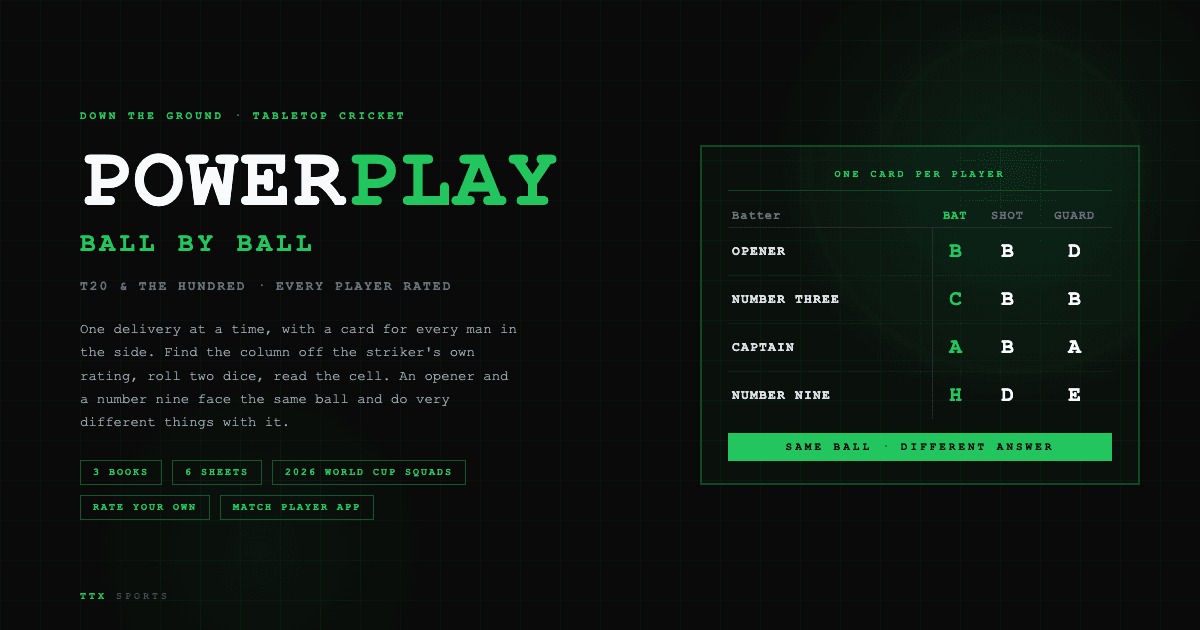
Powerplay does the other thing. Every man carries three ratings: how good he was for his competition, what he did with a bad ball, and how hard he was to get out. You find the column off the striker's own rating, roll two dice, and read the cell. A bad ball sends you to that batter's shot row, so an opener and a number nine facing the same delivery do very different things with it.
Salt getting 41 off 11 and Bethell going at better than a run and a half a ball are not the table being generous. They are those two players, playing the way they play.
Three ways to lose a wicket
Only one of them belongs to the bowler alone. The second is a half chance the field takes or does not, depending on what the captain committed to before the over started. The third is a chance offered, and whether it sticks depends on what the batting side called.
Before every over both captains declare, and both calls cut two ways. Attacking the field makes scoring easier and puts every bowler a wicket closer. Hitting out moves the column and buys a better shot grade, and it costs you five times out of six when the chance comes.
Called at the right moment it wins you the last four overs. Called from the first ball it loses you the match.
What is in it
Three books and seven sheets. The rules, a ratings book with all twenty 2026 T20 World Cup squads and the top four from the men's Hundred, and a tutorial that lays the whole game out as flowcharts. Master ball tables for both formats, in normal and large print. A scoresheet, ten narrative tables that tell you what the ball actually did, a World Cup tracker, and a team sheet for rating your own.
And team cards. All twenty-four sides as cut-out cards, four to a page, every player on one line with his ratings and two pencil columns for the conditions on the day. Deal two out and you never open the ratings book.
There is an offline browser app in the pack as well. It plays the twenty-four rated sides that ship with the game, with animated rolls and a live scorecard.
The first module
This is the start of something rather than the whole of it. Powerplay covers T20 and The Hundred, and the intention is to add the other formats as modules once they are built and tested. The engine is the same underneath, so a side you rate today keeps working.
Rate anybody
Three questions a batter, two a bowler, and you never need a statistic you cannot find. Full figures get a conversion table. A batting average on its own gets a shortcut. Neither of those and there are described bands you can judge a player against from memory.
Your club first eleven. A 1990 Sunday League side. A Test team from before anyone kept a strike rate. Rate them against their own competition and two sides thirty years apart will play a fair match against each other.
Sides are rated on how each man actually played in that tournament rather than on reputation. Ball-by-ball data: cricsheet.org.